

I Stopped Writing Substack Notes. 8 AI Agents Do It Now.
A Claude Code workflow that drafts 35 notes a week in my voice, schedules them, and learns from my edits. The scheduler template is yours.

Writing one good Substack note is easy. Writing 35 a week, every week, forever, is the thing that quietly kills your newsletter.
So I stopped writing them.
I built a tiny newsroom of 8 AI agents to do it instead. Last Wednesday it drafted a full week of notes before I woke up.
It runs on its own every Wednesday at 6pm, the night before I publish my article. Eight agents, one job each. It costs about $6 a month.
And nothing goes out without me. I read and edit every note before it publishes. The system does the heavy lifting. I keep the voice.
💡 One honest thing before we start.
People hear “agent” and picture Hermes or OpenClaw. A bot that wakes up, decides what to do, and runs off on its own. This is not that. Mine is a workflow: eight specialized prompts, run in order by a script, with me approving in the middle. I call them agents because each has a single job and does it well. But it doesn’t pick its own goals. It follows mine.
What this covers
Why 35 notes a week broke me (and why a scheduler alone didn’t fix it)
The newsroom: what each of the 8 agents actually does
The Writer, taken apart: how one note gets built from nothing
The Retro Analyst (the coach), taken apart: how the system learns to sound like me
What I automated, and what stays mine on purpose
What it costs and what it runs on
How to get the scheduler and build your own
This one runs long. It’s the full behind-the-scenes, including two of the agents pulled apart piece by piece. Grab a coffee.
1. Why 35 notes a week broke me
Every growth guide says the same thing. “Post Substack notes consistently.” True. And useless. Because consistency is the entire problem.
The bottleneck was never ideas. It was never writing one note. It was the volume, the rhythm, and the timing. Five notes a day, seven days a week. That is 35 notes, on top of the actual newsletter, client work, and a life.
I did the obvious thing first. I solved the scheduling.
Substack already has a scheduler. The catch: you feed it one note at a time. Paste the text, save a draft, pick a time, then do it all again.
For 35 notes a week, that is soul-destroying. I was too lazy to do it 35 times, so I built a small tool that bulk-schedules from a CSV.
One upload, and it creates all 35 drafts and their posting times at once, using Substack’s own scheduler underneath. That solved the busywork. It did nothing about what to write, or whether what I wrote was any good.
💡 Bulk-scheduling solved the busywork.
It did not solve the blank page. The blank page is the real tax on your newsletter.
Scheduling an empty calendar is still an empty calendar. I needed something that filled it, intelligently, in my voice. That is why the engine exists. The scheduler is the hands. The engine is the brain.
2. The growth engine: 8 agents across 3 phases
Here is the simplest way I can explain it.
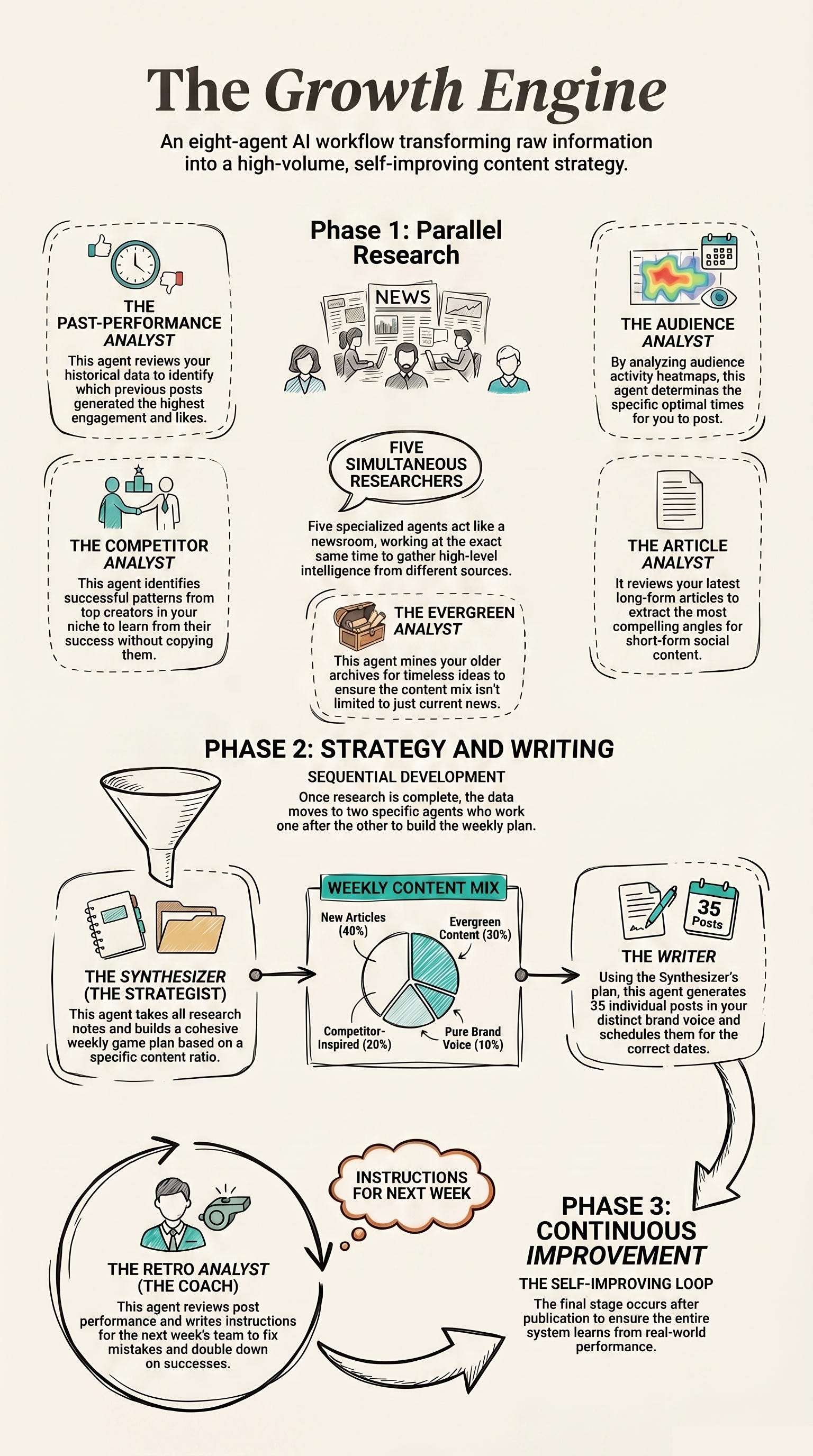
If I had hired humans to run my Substack notes, I would have needed a small team. Researchers, a strategist, a writer, a coach. I did not hire people. I wrote eight prompts instead, gave each one a single job, and called the whole thing the growth engine.
It works in three phases.
Phase 1: Parallel research (five agents at once)
Five agents act like a newsroom, all working at the same time, each pulling intelligence from a different place.
The Past-Performance Analyst reads last week’s actual numbers. Likes, restacks, replies. It says what worked and what flopped, with real figures, not vibes.
The Article Analyst reads my new article for the week and pulls out 10 to 14 angles worth turning into notes.
The Evergreen Analyst mines everything I have ever published for timeless ideas, so the week is not all reactions to current news.
The Competitor Analyst studies the top creators in my niche and spots the patterns worth adapting. Adapt, never copy.
The Audience Analyst reads my engagement heatmaps to find the best times to post.
Phase 2: Strategy and writing (two agents, in order)
Now the research hands off to two agents who work one after the other.
The Synthesizer (the strategist) turns all those notes into one weekly game plan, built on a fixed content mix: 40% from the new article, 30% evergreen, 20% competitor-inspired, 10% pure brand voice.
The Writer takes that plan and drafts all 35 notes in my voice, each one scheduled for the right date.
Phase 3: Continuous improvement (one agent, on a loop)
The Retro Analyst (the coach) runs after the week is over. It reviews how every note performed and writes the instructions for next week’s team: fix the misses, double down on the wins.
That last one is the difference between a tool and a system. The first seven do the work. The eighth makes next week’s work better.
📌 Where to start: you do not need eight agents to start.
You need one good one (the writer) and a clear file describing how you sound. The other seven are how it gets better than you on a tired Tuesday.
Two of these are worth taking apart, because they are where the real work happens. The Writer, which builds the notes. And the Retro Analyst, the coach, which makes next week’s notes better than this week’s. Let me open them up.
3. The Writer, taken apart
The Writer is the agent people assume is the whole system. It is not. But it is the one that turns a plan into 35 finished notes, so let me show you exactly how it does that.
What it reads before it writes a single word
The Writer does not start from a blank page either. Before it writes, it is handed a stack of context. The week’s brief from the Synthesizer. The exact posting times from the Audience Analyst. The angles pulled from this week’s article. The evergreen angles from my archive. The competitor patterns to adapt. My full voice file. My “about me” with my real stories in it.
That last part matters. The writer is not allowed to invent my life. If it writes a personal story, it has to pull from real details I have written down. Real numbers, real places, real moments.
💡 The writer’s quality is capped by the files behind it. Good voice file, good notes. Thin voice file, generic notes. The agent is a mirror, not a magician.
The seven shapes a note can take
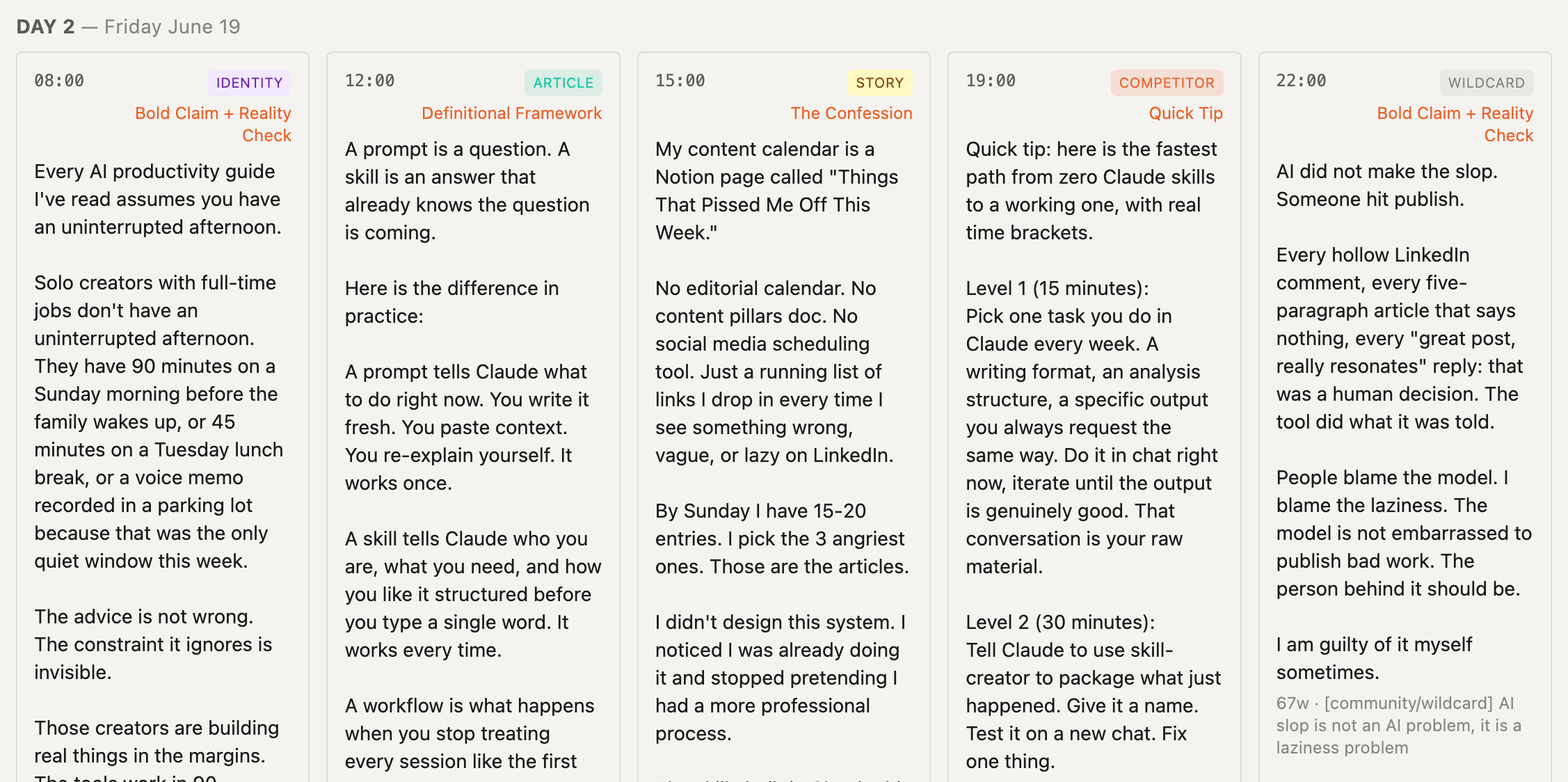
A note is not just “a short post.” For months I have tracked the notes that actually land for creators in my niche, and the winners almost always fall into one of seven shapes. The writer works from those seven fixed formats, and every note has to be one of them.
Imperative Command. Do this. A direct instruction.
Bold Claim plus Reality Check. A strong statement, then the twist.
Definitional Framework. Name a thing, define it in a fresh way.
The Confession. A vulnerable admission that earns trust.
Quick Tip. One small, usable thing.
Ultra-Short Truth. Under 50 words. A single clean observation.
Data Truth. A number that changes how you see something.
The point of fixed formats is rhythm. A feed of 35 notes that are all “bold claims” reads like a robot shouting. A mix reads like a person.
The house rules it cannot break
Here is the part I like most. The writer is forced to live by the same rules I do.
No two notes in a row use the same format.
No two notes open with the same first line.
The first sentence is always the hook. No warm-up.
Specific numbers always. “884 subscribers,” never “almost 900.”
No emojis in the notes. No em dashes. No closing call to action.
A set mix of lengths every week. At least a few under 50 words. A stack of short ones. A handful of longer ones.
These are not suggestions in the prompt. They are hard constraints. If the writer drifts, the rules pull it back.
📌 Steal this: even if you never build the system.
Write your own rules down once, the things you would never publish, and you can hand them to any AI and get something that sounds like you instead of like everyone.
Watch one note get built
Say the week’s plan calls for a personal story note tied to courage.
The writer opens my “about me,” finds a real moment, and builds the note in four beats. The setup. The moment. What it taught me. Then the line that hands the lesson to the reader.
So it might pull the time I landed in Costa Rica at 19, alone, unable to count to three in Spanish. Setup. The moment I realized no one was coming to translate for me. The lesson, that being lost in public is the price of learning anything fast. Then the turn to the reader: if you are four months into something new and crying, that is the part where it works.
It writes that as one tight note, around 150 words, in the Confession format, and stamps it with a posting time. Then it does that 34 more times, in different shapes, on different angles, never repeating an opener
.That is the Writer. A very fast, very disciplined drafter that never gets tired and never breaks the house style. What it cannot do is know whether any of it actually worked. That is the next agent’s job.
4. The Retro Analyst, taken apart (the coach)
This is the agent I did not expect to love. The Retro Analyst, the coach, is what turns a clever drafting tool into a system that gets better every week.
It runs after the week is over, once the notes have collected real engagement. And it reads three things most people never think to feed back in.
One: the numbers, scored the right way
The Coach pulls the actual likes, restacks, and replies for every note. But it does not just add them up. It scores each kind of note on the thing that note was trying to do.
A story note is judged on likes and replies, because its job is to make people feel something. An identity note, the kind that says “this group deserves more visibility,” is judged on restacks, because its job is to be amplified. A question note is judged on replies, because its job is to start a conversation.
💡 Most dashboards average everything into one number. That hides the truth.
A note with 2 replies and 40 restacks did not fail. It did exactly its job. You just have to score it on the right scale.
So the Coach writes a scorecard. Best note on likes. Best on restacks. Best on replies. Often three different notes. Then a verdict per format: pulled its weight, or did not, in plain numbers.
Two: my edits, which are the real gold
Here is the part that surprised me.
The Coach reads the edits I made by hand. Not the notes I approved as-is. The ones I rewrote before publishing.
It treats every edit as a correction. It compares what the writer drafted to what I actually published, and it looks for the pattern. “She cut the throat-clearing opener from three notes.” “She removed the closing call to action every time.” “She shortened a two-line hook to one line.”
Those patterns get written into a running voice file. A flat list of rules. Next week, the Writer reads that file before it drafts anything.
💡 The system does not get better because I tune it. It gets better because it watches me. My edits are the training data.
The first few weeks, I rewrote a lot. The notes were fine, but they were not mine. They had that faint smell of AI trying hard. Now I rewrite less. Not because of magic. Because of a loop that compounds, one corrected note at a time.
The voice file is capped, on purpose. It holds the strongest rules, not every passing whim. If a new correction contradicts an old one, my latest behavior wins and the old rule is dropped. It is a living style guide, written by my own red pen.
Three: a plan for next week
The Coach does not just grade the past. It writes hypotheses for the future, and it states them like bets.
“If we run two identity notes next week instead of one, expect weekly restacks to grow about 80 percent, based on this week’s numbers.” “If we move the identity note to Tuesday morning, expect more restacks, based on the Tuesday peak.” Then it hands the next Synthesizer a short list of changes to make.
📌 The takeaway: this is the difference between posting and learning.
Most people post, glance at the likes, and move on. A simple weekly retro, even one you write by hand, compounds harder than any single viral note.
And because I asked it to be a truth machine, not a hype machine, the Coach is blunt. If a format flopped, it says so in numbers and tells next week to do less of it. It is the colleague who actually remembers your feedback, and is not afraid to tell you the thing did not work.
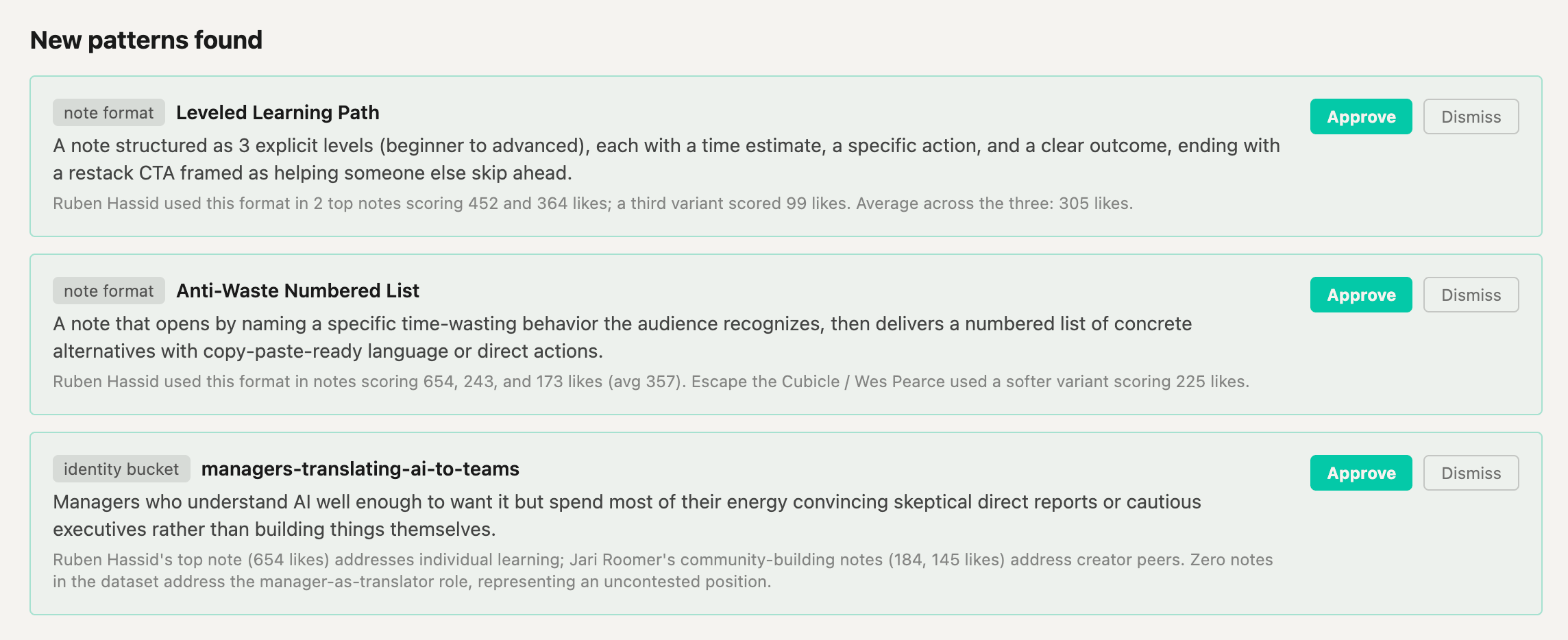
5. What I automated, and what stays mine
I stole my golden rule from a creator I read, Daria Cupareanu from AI blew my mind. Automate the work you dread, not the work that is you.
Here is where I drew the line.
Automated: the research, the timing, the first draft of all 35 notes, and the weekly retro. The heavy, repetitive, soul-draining volume. The stuff I would never get to on a busy week.
Stays mine: the final edit, the approve button, and the voice. Nothing publishes without me reading it. The newsletter article itself is never touched by this system. That is the part I love, so I keep it.
📌 The rule: automate the work you dread, not the work that is you.
For me, drafting volume is the dread. Voice is the part I refuse to hand over.
And because I am a truth machine, here is where it still fails.
It over-rates its own work. The Coach’s grades are a starting list, not a verdict. I still decide what was actually good.
It drifts toward generic when the week’s article is thin. Weak input, weak notes. Garbage in, garbage out is not solved by AI.
The timing is a guess. Substack does not tell you when your readers are actually online. So the Audience Analyst uses my own past engagement as a proxy. Useful, but not the same as truth.
None of these are dealbreakers. They are just the honest shape of the thing. Anyone who tells you their AI system runs itself perfectly is selling you something.
6. What it costs and what it runs on
You do not need to be technical to follow this part. Promise.
The whole thing runs in the cloud on a schedule. It fires itself every Wednesday at 6pm, drafts the week, and emails me when the drafts are ready. My laptop can be closed. I can be asleep, or out, or on a train.
It is built on tools that are free or nearly free. A small web app on Vercel’s free hobby plan for the dashboard. A free Supabase database to remember everything. Claude doing all the thinking. Add it up and it costs about $6 a month. That is roughly $1.50 a run, once a week.
When I open the dashboard, I read the brief, edit the notes I want to change, and click one button. Approve and push to scheduler.
The engine hands the finished list to my bulk-scheduler as a CSV. The tool creates all 35 drafts in Substack at their scheduled times in one go. No more pasting a note, saving a draft, and setting a time, 35 separate times.
💡 This is not enterprise software. It is a folder of plain-text prompts and one small app. You could read the whole thing in an afternoon.

7. Build your own
Here is the honest path, in the order I would do it again.
Start with the scheduler. It is the simplest piece and it solves the most annoying problem first, the timing. Get comfortable handing it a list of notes and watching them go out on their own.
Then add a writer. One prompt, one good voice file, and you have a first draft instead of a blank page. That alone changes your week.
Then layer the rest of the team as you learn what you actually want. The analyst. The scout. The coach. You do not build all eight on day one. I did not either.
The three files that do 80 percent of the work are not code. They are your voice profile, your “about me,” and your list of writing habits to avoid. The agents are only ever as good as those three files. Spend your time there.
📌 Do this tonight: write one file describing how you actually sound, then feed it to a single note-writing prompt. That is day one of your own newsroom.
The deal. I am giving the scheduler template away. Recommend the brisk. newsletter, and the scheduler repo is yours. The code, the setup steps, all of it.
I am keeping the full engine private, because it is wired so tightly to my voice and my data that it would not help you as-is. But if you want to build your own version of the eight-agent engine, reply to this email and tell me. If enough of you are interested, I will write up exactly how I set mine up.
And if you would rather watch me build it, I recorded a full walkthrough with Sabahudin Murtic 🎁 where I share my screen and go through the whole setup, step by step. Watch it here:
One month ago, the notes were the part I dreaded most. Now they are the part I think about least.
You can keep writing 35 a week by hand. Or you can spend one weekend teaching a system to draft them, and get your Wednesdays back.
Recommend brisk., grab the scheduler, and go build your newsroom.

PS - Let me know how it goes. I encourage you to share ….
If you are interested in seeing my growth engine repo on GitHub, please reach out to me in the comments. If enough people do so, I will make it a public template.
You are not a subscriber? Change it now!
This article is part of my ongoing series on making AI simple and useful for non-tech people. Subscribe to get future articles on AI tools that actually matter for everyday life. And if you found something that helped you - sharing is caring 😉
I loved this article! I’m only a lurker on Substack but I’m envisioning building something like this for my business Instagram. I’d love to know more specifics of how you actually built this.
Hello
I loved your article and just recommended Brisk.
Can you please share the Sheduller.